The creation of a new efficient
propeller asks for knowledges in a number of fields, which are a
mixture of art and technology.

|
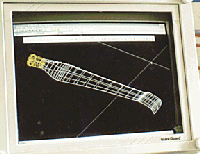
As often in the aviation field, innovative progresses are first intuitive, and will little by little be controlled and carefully checked, first with calculations according aerodynamic laws, then by trials with prototypes. Vincent Duqueine, who formerly invented the Windbreak (kind of winglet allowing a better airflow at the tip of the blade, hence a better efficiency), successfully used on former productions, wished to offer ultralight owners a propeller that would have a better efficiency, turning slowly, being more cost effective and making less noise. This brought him to develop a new concept, based on his long years' experience in propellers and high-tech materials.. The three main innovations in the DUC FC are geared towards ensuring a better airflow over the whole area of the blade, and offering a better strenghtness. This of course required a lot of study work, leading little by little to the very special profile of the DUC FC blade, and to a new invention: the Windspoon.
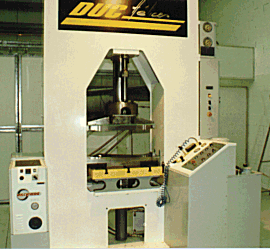
One word about Rohacell: Why use an especially expensive foam to build the kernel of the blade, while other manufacturers use less specific foams ? Simply because the Rohacell, within very specific heath and pressure conditions, will generate a push from within (expansion) the blade during its forging. The carbon is hence taken as a sandwitch between the pressure generated by the machine, and the one of the Rohacell kernel. DUC Hélices tested numerous foams before electing this one as the only one able to ensure the quality level required of the finished product. And about carbon: It is available in a number of fashions, basically as fabric, as unwoven unidirectional fabric, and as nappa. DUC Hélices only uses industrially preimpregned nappa - thus warranying the homogeneity of the production along the time - for its quality: the way the different layers will in the end ensure the mechanic and dynamic qualities of the propeller. Here again, this high-end basic product is a need for a high quality product as the DUC FC. From the very first drawings to its production, the DUC FC was designed for efficiency and long life. |
Copyright ã DUC Hélices, ULM Europe 1997, 1998, all rights reserved worldwide